

How did you start shooting? Were you inspired by the Kashtan community?
No, it all started much earlier. I was given a point-and-shoot camera for my birthday, and for a while, I shot on cheap Kodak Color Plus. Then I neglected it. My interest returned when a barber named Sasha lent me a DSLR to test. My first roll came out out of focus: I knew nothing about exposure or aperture. I borrowed that camera again when I went on my first trip with Liza. There, I shot two top rolls: out of 72 frames, 60 turned out amazing. And I thought, "Wow, maybe I have talent." Of course, I had to return the camera, but the thought remained that this shot — is not just a photograph.

Earlier you knew nothing about exposure, and now you take cool shots. Tell us a bit more about your evolution as a photographer.
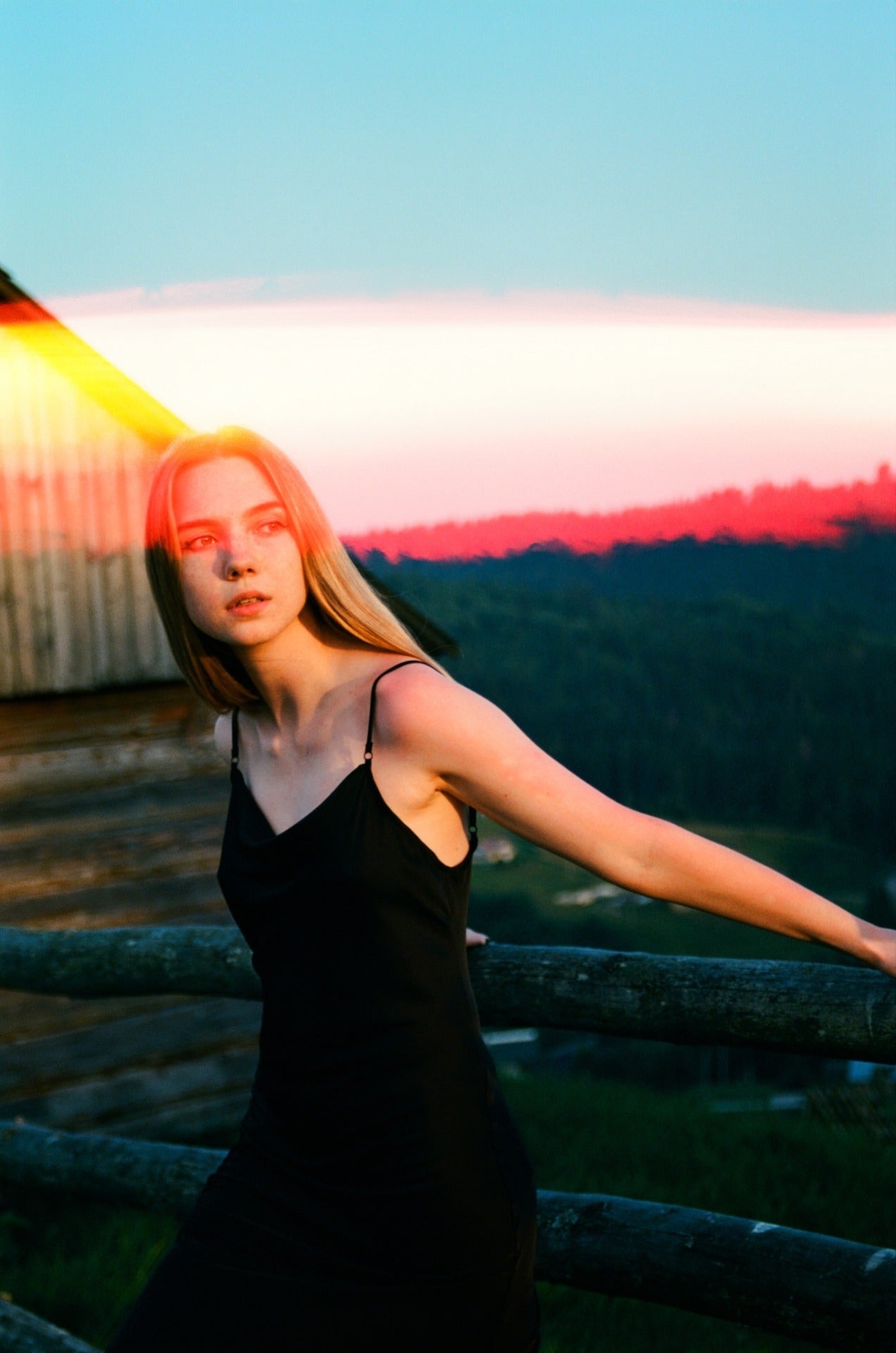
I started studying the technical side: what lenses are about, how to change exposure beyond the standards, and what results you can get in the end. And it started working out. Then I faced a problem: the camera overexposes part of the shot. I began asking where I could get it repaired. But eventually, I concluded that it’s part of my style. Even when photos are posted without tagging me, it’s clear that I took them because of the characteristic overexposure.

Yes, some even think you edit them that way on purpose.
I don’t edit photos at all. Film is something you load — and that’s it, you don’t have to do anything else. Either I feel the camera, or the camera feels me. It’s like with knives or weapons when they become an extension of your hand. But I don’t like that kind of metaphysics much. I understand that for me it’s a tool that helps convey information and nostalgia.
How many rolls have you shot in total?
Probably a little over 1000 frames in total. With this camera, I remember every moment, every state I went through. It’s like a transcendental experience. You can even draw a parallel with tattoos. I remember what I felt during the session, what I said, and what thoughts I had. So my physical sensations are supported by something psychological. For me, film — is a sublimation of everything I experience.
Why film?
I like the feeling that I’m shooting on film and staying offline. Photos are stored in the physical world as negatives. Futurism and the idea that soon we’ll communicate through built-in earbuds over distances — that’s all cool. But I need to touch things, I’m a visual, auditory, kinesthetic person. I need something to rustle, click somewhere, some sounds. That’s why there’s always a childlike excitement during shooting.

What is your approach to photography?
It doesn’t matter what you photograph, what matters is what you feel during it. Besides your memories, we own nothing. So by shooting on film, you preserve the moment and stop time. I don’t photograph things I wouldn’t want to remember. I basically don’t photograph landscapes in life. Why? You can collect the whole world just from photos. There’s no place left where no one has taken a picture yet.
Do you promote yourself as a commercial photographer?
Not exactly. It’s mostly word of mouth. I have a few brands I collaborate with regularly. Either they send me clothes, and I plan and shoot everything myself, or they come and hire me as a photographer.
I shoot exclusively on film. I don’t like digital shooting because of the overwhelming choice. They take 3-4 thousand frames and select 200. Why so many?

Do you have any ambitions or plans to become a photographer?
I never plan ahead. The less you reach for something, the more you get because you free up a lot of space inside yourself. When you want something too much, you start grasping for it convulsively and worry a lot. And when you work with people and photography, you have to stay soft and calm.
How should you work with people in front of the camera?
Nowadays, you don’t need to “pose” someone correctly or choose a perfect angle. You feel how the person feels and try to convey that through the photo. If I don’t communicate well with the person I’m photographing, I won’t be able to make a good shot of them. I tried doing shoots for acquaintances — it’s not the same at all. We have to be close, connected. If I don’t feel the person’s dynamics, I can’t capture them. It will be a photo of a statue.

Liza gave you a Fujifilm Instax Mini 11. Do you like it?
She says, "Haha, tell them I bought it for myself." She uses it for her shoots. I immediately appreciated the gift — it’s very easy to work with. We have a mood board at home. Our joint photos hang there on clips. I also have an idea to make a series called "12 Moods of Liza": take many photos in 12 different countries. Then I want to make a mini-calendar from it. Oh, and I carry the Instax shots in a case.
What would you spend your last frame on?
You shouldn’t give yourself answers to questions in advance, you can’t overthink it. You need to treat photography simply. It’s not the end of the world.
But actually — it’s all about love. I’d probably photograph Liza or take a selfie together.
