

That brings our mini-series about film to an end. Today, in the final article, we will explain how we develop black-and-white film. Enjoy reading :)
Black-and-white development schedule
As you probably know, sometimes you have to wait longer for black-and-white scans than for color scans. The reason is that we develop black-and-white film by hand and only three days a week: Monday, Wednesday, and Saturday. So don’t forget this when you want to receive your photos as quickly as possible ;)
In general, we recommend bringing black-and-white film in one day before development. The schedule is simple:
if you bring it in on Monday or Tuesday, you will receive them on Wednesday;
if you bring it in on Wednesday, Thursday, or Friday, you will receive them on Saturday;
if you bring it in on Saturday or Sunday, expect the photos on Monday.
Preparing the film for development
Everything is the same as with color film - begins at the store. First, we will ask what film you have (the manufacturer and type) and what ISO it was shot at. This is important to know because development times vary for different films at different ISO settings. At the store, you can also tell the staff which format you would like to receive your scans in—JPG or TIFF. Just remember that TIFF scanning takes more time.
We will write all the necessary information on the envelope with your film and send it to the lab.
At the lab, we will prepare the film for development: pull out the tab with a pick, trim the edge, and attach an individual number to the film and the envelope.
Then, in the special The Massive Dev Chart app we find out how long and in which chemistry a particular film needs to be developed. We mostly use Kodak X-Tol developer, but if it is unsuitable (which happens quite rarely), we use another appropriate one. We will write all the important information on the envelope with your film: the development time, the solution, and its ratio.
Preparing the developing machine
Our JOBO Duolab developing machine gets a lot of attention :) We wash it regularly, take meticulous care of it, and check that it is working properly every time before we begin.
Immediately before developing, we fill the machine with “Iceberg” water, wait until it reaches the required temperature, and prepare the solutions. Each one is kept in a specific bottle and mixed strictly according to the instructions.
Everything is almost ready; all that remains is to wind the film onto the reel. This is done inside a dark sleeve so the film is not exposed.
Inside the sleeve, we take the reel, attach the film leader to it, and start winding the film. Once it is completely on the reel, we put the reel into the tank and close it with a tight lid. The film can now be taken out of the sleeve.
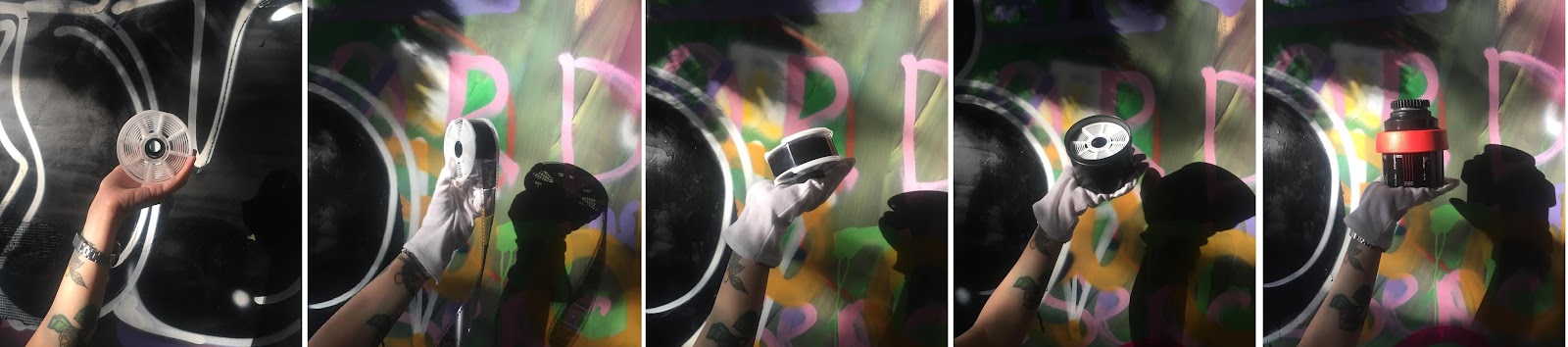
The photos were taken solely to demonstrate a process that actually
takes place in complete darkness inside a special sleeve.
Developing black-and-white film
When the film is in the tank, the solution is at the correct temperature, and the time is set, you can begin the actual developing.
In the machine, the film is processed with developer, then fixer, followed by a water rinse. After developing and rinsing with water, the film sits for several minutes in in a special final-rinse solution. Then we carefully hang the film with a clothespin on a line to dry completely.
During drying, streaks or spots sometimes remain on the film—we always remove them :)
Scanning
We already wrote about scanning in the previous article.But it is worth repeating here: we have three scanners—Kodak, Noritsu, and Epson.
1. Kodak Pakon F-135 Plus
It is typically used to scan type 135 film (35 mm). It scans at a resolution suitable for 20×30 prints.
2. Noritsu HS-1800
We use it to scan medium-format film (type 120). The Noritsu can also scan type 135 film if you want to print your photos in a large format or simply receive higher-resolution scans (40×60).
3. Epson Perfection V550
We use the Epson to scan 110-format narrow film and instant photos from Fujifilm Instax and Polaroid.
After scanning, we upload the photos to the server, send an email and an SMS, and package the film. Some people prefer to store film in boxes, while others prefer sleeves. You can choose the option that works best for you and specify it when placing your order.
Cost of developing and scanning black-and-white film
Developing + scanning a type 135 black-and-white film — 120 hryvnias
Developing + scanning a type 120 black-and-white film — 250 hryvnias
More details on the developing and scanning page: https://fotovramci.com/en/pages/proyavka-plivky